
Carbon Data and What Is Required to Pass a Carbon Audit

Written by: Lanre C. Oluborode
Last Updated: December 31, 2025.
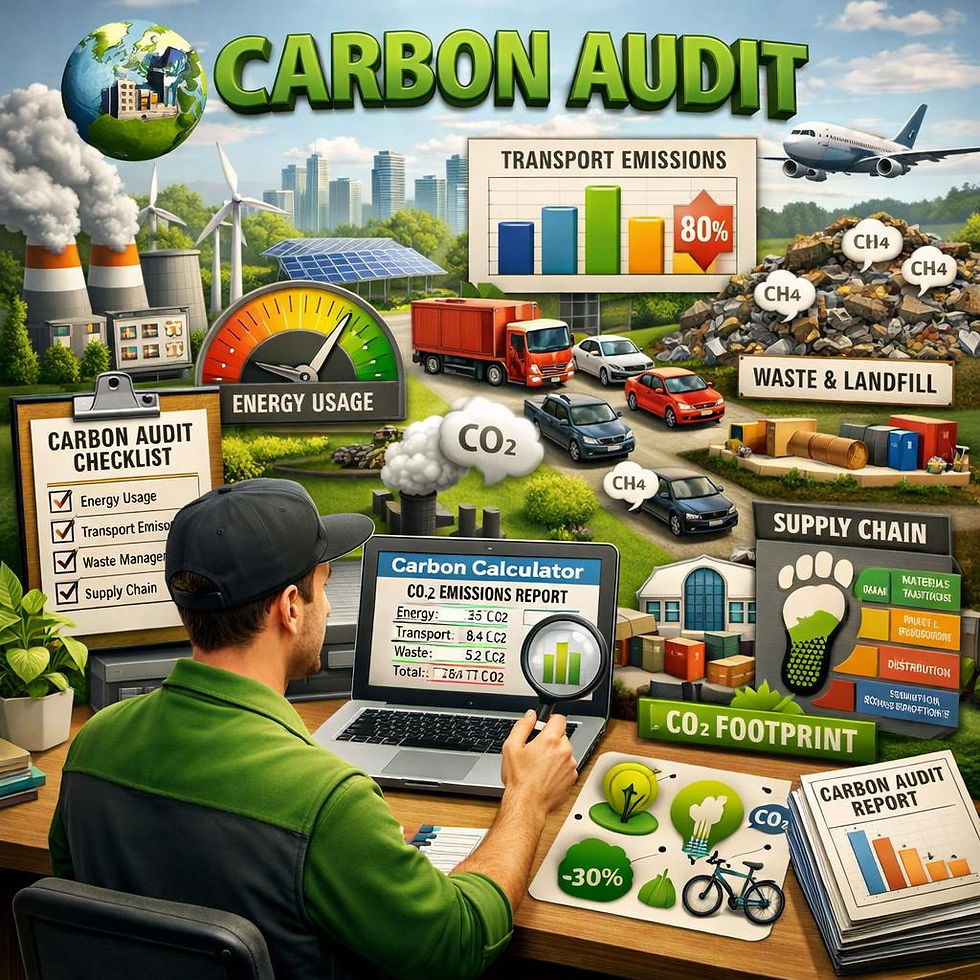
Carbon audits are no longer theoretical exercises or voluntary disclosures. For many organisations, they sit alongside statutory reporting, tender qualification, lender scrutiny, and board-level risk management. As a result, the quality of carbon data is increasingly being tested under formal audit and assurance processes.
Many organisations are surprised when their carbon data is challenged or rejected. In most cases, the issue is not intent or effort, but a misunderstanding of what audit-ready carbon data actually requires.
This article explains:
What auditors expect from carbon data
What “audit-ready” really means in practice
The most common reasons carbon data fails during audits
How organisations can structure carbon data to withstand scrutiny
What Is a Carbon Audit?
A carbon audit is an independent review of an organisation’s greenhouse gas (GHG) data to assess whether it is:
Accurate
Complete
Consistent
Traceable
Aligned with recognised standards
Carbon audits commonly occur in the context of:
Statutory reporting (e.g. SECR)
Energy and carbon compliance reviews
Public-sector procurement (e.g. Carbon Reduction Plans under PPN 06/21)
Voluntary or mandatory assurance against the GHG Protocol
Net zero and climate claims scrutiny
Auditors are not there to judge ambition. They are there to test defensibility.
The Standards Carbon Audits Are Judged Against
While requirements vary by scheme, most carbon audits reference a consistent core set of frameworks:
GHG Protocol Corporate Accounting and Reporting Standard
GHG Protocol Scope 3 Standard (where applicable)
UK Government GHG Conversion Factors for Company Reporting
UK statutory guidance for energy and carbon reporting
Public-sector technical guidance for carbon reduction plans
Passing a carbon audit depends on how well an organisation aligns with these expectations and not on how polished the final numbers look.
What ‘Audit-Ready’ Carbon Data Actually Means
Audit-ready carbon data has five defining characteristics:
Clear organisational known boundaries
Verified and complete activity data
Consistent and justified calculation methods
A documented audit trail
Governance and accountability
When any one of these is weak, audit risk increases significantly.
Why Carbon Data Commonly Fails During a Carbon Audit
1. Poorly defined organisational boundaries
Auditors require clarity on what is included and why.
Common issues include:
No documented approach to operational vs financial control
Inconsistent treatment of subsidiaries or joint ventures
Leased assets included one year and excluded the next
Group restructures not reflected in reporting boundaries
Without clear boundary definitions, emissions totals cannot be compared year-on-year, making the data unreliable.
Audit impact: Loss of comparability and material misstatement risk.
2. Inconsistent or unjustified emission factors
Carbon calculations are only as credible as the emission factors used.
Common failures:
Mixing emission factors from different years
Using outdated UK Government conversion factors
Applying third-party factors without justification
Failing to document which factor set was applied
Even when calculations are mathematically correct, inconsistency undermines audit confidence.
Audit impact: Non-compliance with recognised reporting guidance.
3. Incomplete activity data and uncontrolled estimates
Auditors expect organisations to prioritise actual data and tightly control estimates.
Common issues:
Missing fuel or electricity data
Reliance on estimates without thresholds or rationale
No explanation of data gaps
Assumptions embedded in spreadsheets but undocumented
This is particularly common for:
Multi-site organisations
Leased buildings
Transport and logistics
Scope 3 categories
Audit impact: Increased uncertainty and risk of material error.
4. Selective or inconsistent Scope 3 reporting
Scope 3 emissions are not always mandatory. However, once reported, they must meet the same standards as Scope 1 and 2.
Common failures:
Reporting only “easy” Scope 3 categories
Changing included categories year-to-year without explanation
Using spend-based methods with no supplier logic
Excluding major emission sources without justification
Auditors focus heavily on consistency and transparency, not completeness alone.
Audit impact: Credibility challenge and potential misrepresentation.
5. Lack of a documented audit trail
This is one of the most frequent reasons carbon data fails assurance.
Auditors expect:
Source data (invoices, meter reads, supplier reports)
Clear calculation methodologies
Version control and change logs
Reconciliation to energy and financial data
Common failures:
Spreadsheet-only calculations with no controls
No evidence pack
No explanation of adjustments or corrections
Even accurate numbers can fail if they cannot be verified.
Audit impact: Data cannot be assured.
6. Misalignment with financial and energy records
Carbon data does not exist in isolation.
Auditors routinely cross-check:
Energy consumption vs invoices
Carbon totals vs energy costs
SECR figures vs statutory accounts
Carbon data vs ESOS evidence
When figures do not reconcile, confidence collapses.
Audit impact: Questions over data integrity and governance.
7. Incorrect use of carbon offsetting
Offsets are frequently misunderstood and misused.
Common failures:
Offsetting before establishing a robust baseline
Using offsets to compensate for poor data quality
No justification for offset type or standard
Making reduction claims without evidence
Auditors expect offsetting to address residual emissions only, following credible reduction efforts.
Audit impact: Reputational risk and potential non-compliance.
8. Weak governance and accountability
Carbon reporting is increasingly treated like financial reporting.
Auditors look for:
Clear ownership of carbon data
Defined review and approval processes
Senior accountability
Error correction mechanisms
Common failures:
Carbon reporting treated as a one-off exercise
No named data owner
No senior sign-off
Audit impact: Low assurance confidence, even where data appears sound.
What Organisations Must Do to Pass a Carbon Audit
To consistently pass carbon audits, organisations must shift from producing carbon numbers to managing a carbon reporting process.
This requires:
Clear boundary definitions aligned with recognised standards
Controlled estimation methods
Documented methodologies and assumptions
Reconciliation with financial and energy data
Strong governance and accountability
Carbon data must be:
Repeatable
Defensible
Transparent
Comparable year-on-year
The Core Reality
Carbon audits rarely fail because organisations act in bad faith.
They fail because carbon reporting is treated as a technical output rather than a controlled, auditable process.
As scrutiny increases from regulators, auditors, procurement teams, and lenders, this distinction is becoming critical.
Organisations that treat carbon data with the same discipline as financial data are the ones that pass audits consistently.


Comments